|
A Long Last Look At Titanic by Robert D. Ballard
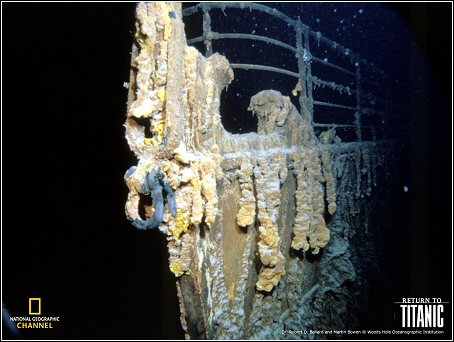
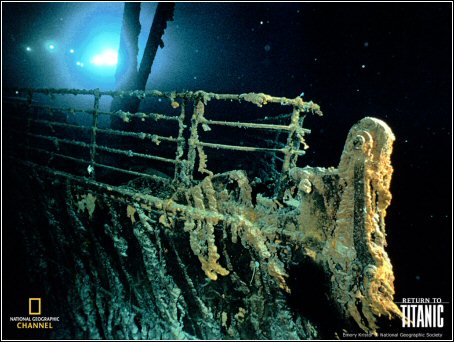
My lifelong dream was to find this great ship, and during the past 13 years the quest for her had dominated my life. Now, finally, the quest was over. In a way I am sad we found her. After 33 hours of exploring her dismembered hulk, we know her fate, and it is not a pretty sight. Though still impressive in her dimensions, she is no longer the graceful lady that sank a mere five days into her maiden voyage, in 1912, after striking an iceberg. Her beauty has faded, her massive steel plates are dissolving in rivers of rust, and her ornate woodwork has been devoured by an army of countless wood-boring organisms whose hollow calcium tubes now litter her barren shape. After years of gluttony the creatures starved and dropped dead at the table. I have no sympathy for them; they robbed Titanic of her last touch of elegance. Titanic's band has long since ceased to play. She is gone, home-ported at last. She will surely never be raised. Such stark reality often offends our romantic senses, but the search for this greatest of all sunken ships was first and last an exciting journey. First, it was almost too exciting.
Then, another cruncher. Ralph noticed salt water leaking into one of the two battery packs that powered the small sub. It showed up on our instrument panel as a slow leak, but as the level of seawater in the battery tub rose, the leak caused us concern, for the protective oil in which the batteries are bathed was being replaced by short-circuiting seawater. Alvin's batteries eventually could consume themselves. Bottom time would be short—if at all. Finally, as we closed with the bottom, faint features emerged from the green gloom. No Titanic, no debris, just a gently rolling countryside of mud—much like an alpine meadow after a blanket of snow has all but erased its features. When our tracking system is working properly, the navigator on the surface knows where he is, where we are, and where Titanic lies, but the navigator was now having problems. We did not know what they were, only that his directions, echoed down to us on the underwater acoustic telephone, indicated he was lost. To be so close—but to be so far away. Somewhere out there lies Titanic, just a few hundred meters away, perhaps less than the distance from home plate to the center-field wall in Fenway Park. And those damn alarms have started. Seawater is continuing to short-circuit our batteries, and Ralph is already thinking about returning to the surface. The snowstorm of underwater particles is blowing toward us from the south-southeast. Clearly, the current must have set us to the north of our desired location. Titanic should lie south. We begin driving in that direction, the single ski mounted under Alvin making us a one-legged skier gliding downslope over virgin snow, a single track left behind us for roaming crabs to exploit. The alarms inside Alvin shrill as more and more seawater enters our battery pack and the electrical situation gets worse. Ralph is about to pull the plug. Finally, a voice from above: 'Alvin, this is AII. Tracking is working, Titanic should bear 50 yards to the east....' As we turn east, our pace quickens and our eyes strain to see. The bottom begins to look strange; it begins to slope up suddenly, steeper than it should, into a mound of mud and small glacial boulders dropped through eons of time by slowly melting icebergs, including the one that sank Titanic. It has a bulldozed look, and what a bulldozer lies just beyond! 'Ralph,' I say. 'Come right.'
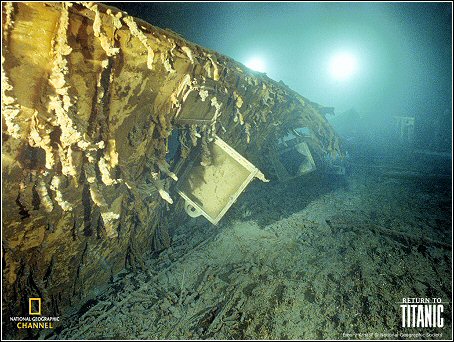
Most of the 11 dives that followed were more rewarding, such as the one that confronted the historic question of 'the gash.' Most accounts of Titanic's loss attribute the disaster to a 300-foot-long gash ripped into the liner's starboard bow by the iceberg. I had long doubted such reports, for Titanic's massive steel plates probably would have been bent or forced apart rather than ripped open by ice. During one of our later dives we guided Alvin to a landing beside Titanic's bow, driven deep into the mud of the ocean floor by the enormous momentum of the plunge from the surface. On impact the bow had shifted slightly to the left, leaving a gap between the bank of mud and the ship's starboard side. As we moved slowly along that vertical wall of steel, I half-expected to see a tear in the plates. But there was nothing—only an indication that the plates had bent inward and the rivets bolding them together perhaps had sprung, allowing seawater to enter. Still photographs taken later of the section indicate at least one hole in the plates, so the question may never be fully answered. Other dives produced vivid cameo scenes that will also remain with me forever. As we explored Titanic cautiously, peering at her from inside Alvin or via our 'swimming eyeball,' the robot Jason Jr., we came upon such haunting scenes as the disembodied head of a child's doll, lying amid the vast field of debris dumped loose when the ship broke up on or near the surface. Then there was the fragile cup balanced delicately atop one of the ship's massive steam boilers. Small electric space heaters scattered throughout the debris field were a pathetic reminder of the comforts enjoyed so briefly on that doomed voyage. In such ghostly surroundings impersonal features took on human characteristics. On one dive, as we moved in slow motion along the hull, the darkened portholes seemed to me like rows of sightless eyes brimming with great tears of rust. The more we explored Titanic, the more her parted sections assumed wholly different characters. The bow still had a certain dignity to it, but the stern section was utter devastation. It was here that passengers and crew had gathered to face the awful specter of death. Exploring with Alvin, we eventually chose a spot beside the rail of the stern section to place a bronze plaque from the Titanic Historical Society commemorating the ship's … lost souls.
The day is fast approaching when that job can be done faster and better without man's physical presence in the sea. Until recently there has been no way of duplicating human skills at great depth—of providing man's sophisticated eyes and brain and articulating hands to solve complex problems or perform difficult tasks. Whatever the cost, and the risks, of transporting man into the deep, it has been worth it.… It seemed to me we had a choice. We could continue indefinitely with manned submersibles, which are limited in the time they can spend below by both their passengers' endurance and their expendable power supply. In a sense they are no better than a scuba diver who, air supply exhausted, must race back to the surface. On the other hand we could begin thinking of remotely operated deep-sea vehicles, sophisticated robots that could give man what I have come to think of as a 'telepresence' in the sea, an extension of his unique senses and capabilities to extreme depths without physically transporting him a foot below the surface. Through such robots man could remain under the sea for weeks instead of mere hours at a time, extending his reach immeasurably into earth's last great uncharted frontier. Equally important, via live television these machines could bring the wonders of the deep to countless millions rather than to the lucky few who are able to ride in submersibles. From the very outset of that vision Titanic seemed the key. The cost of developing deep-diving robots is astronomical, requiring a dramatic image or goal to capture public interest and support. Nothing in modern maritime history fits that description better than Titanic. My first real hope of finding and filming Titanic came in the 1970s, when the undersea research group at the Woods Hole Oceanographic Institution decided to more than double Alvin's depth range from 6,000 to 13,000 feet. The latter, I knew, was roughly the level at which Titanic lay. Alvin seemed the perfect deep platform to begin experimenting with robotic vehicles—first as extensions of manned submersibles, and ultimately as their replacement.
Over the years, as I continued diving in manned submersibles, I kept careful note of ways in which robotics could overcome their limitations. New technologies such as fiber optics and lasers broadened the dimensions of what robots could do beneath the sea. I envisioned a remotely operated system involving two components, which eventually became known as Argo/Jason. Argo was to be the eyes of the system and Jason the hands, both elements extraordinarily sophisticated. When perfected, the system would be able to search out objects or natural features at extreme depths, analyzing and recording them for as long as the surface operators wished. In the case of lost objects, Argo/Jason could either recover them or direct their recovery by other means. By September 1985 Argo was ready for testing at sea. During the historic discovery of Titanic by the U. S.-French team, Argo exceeded our highest hopes; the robot's ultrasensitive 'eyes,' or video cameras, could see and record in almost total darkness. The next step was to give Argo a hand. By last summer the system had the beginnings of one in the form of Jason Jr., our 'swimming eyeball.' A more sophisticated version of 'J. J.,' known simply as Jason, will attach to Argo and will have not only cameras but also highly versatile arms able to perform complex jobs in areas where no manned submersible could ever safely go. With Argo not yet ready for a partner, we attached J. J. to Alvin instead. The world's finest manned submersible thus played a key role in developing and testing a system that may one day replace its own kind. Admittedly J. J. had its share of problems on Titanic. Returning from one dive, it fell out of its 'garage,' or housing, aboard Alvin, and only quick work by our support divers prevented a million-dollar loss. On another dive, when I remained on the surface, J.J. suffered an electronic stroke.… Fortunately the trouble, which proved to be a saltwater leak in J.J.'s tether, was quickly repaired, and the robot was soon ready to dive again. But the incident proved the point that when something goes wrong at 12,500 feet, you don't just get out and fix it. The only answer is to build systems that don't risk human life. This winter the marriage of Argo and Jason will begin aboard the research vessel Knorr, the ship that discovered Titanic. Within two years Argo/Jason will be ready to enter the deep and remain there for extended periods, adding greatly to man's knowledge of the undersea world. But the quest for Titanic is over. May she now rest in peace. Source: Ballard, Robert. “A Long Last Look at Titanic.” National Geographic, December 1986. Titanic Photos Available as Deskto Wallpaper © National Geographic Society
Click to see my HOME page
|